A New Political Era
South Africa entered a new political era following the 2024 general election. For the first time since 1994, no single party won an outright majority in the National Assembly. The result forced parties that had spent years competing against one another to sit at the same table and negotiate a shared way forward — the Government of National Unity (GNU).
Coalition governments, by their nature, require compromise. Parties must reconcile very different manifestos, philosophies and voter expectations into a single programme of government. Supporters view the GNU as a necessary arrangement that delivers stability, keeps extreme positions in check and reassures investors. Critics, however, question whether some parties quietly shifted away from the very positions they campaigned on once the responsibilities — and constraints — of governing set in.
This article examines that tension. It is written for ordinary South Africans who feel the consequences of political decisions long after the headlines fade — in the price of fuel, the cost of electricity, the rate on a home loan and the affordability of monthly debt repayments.
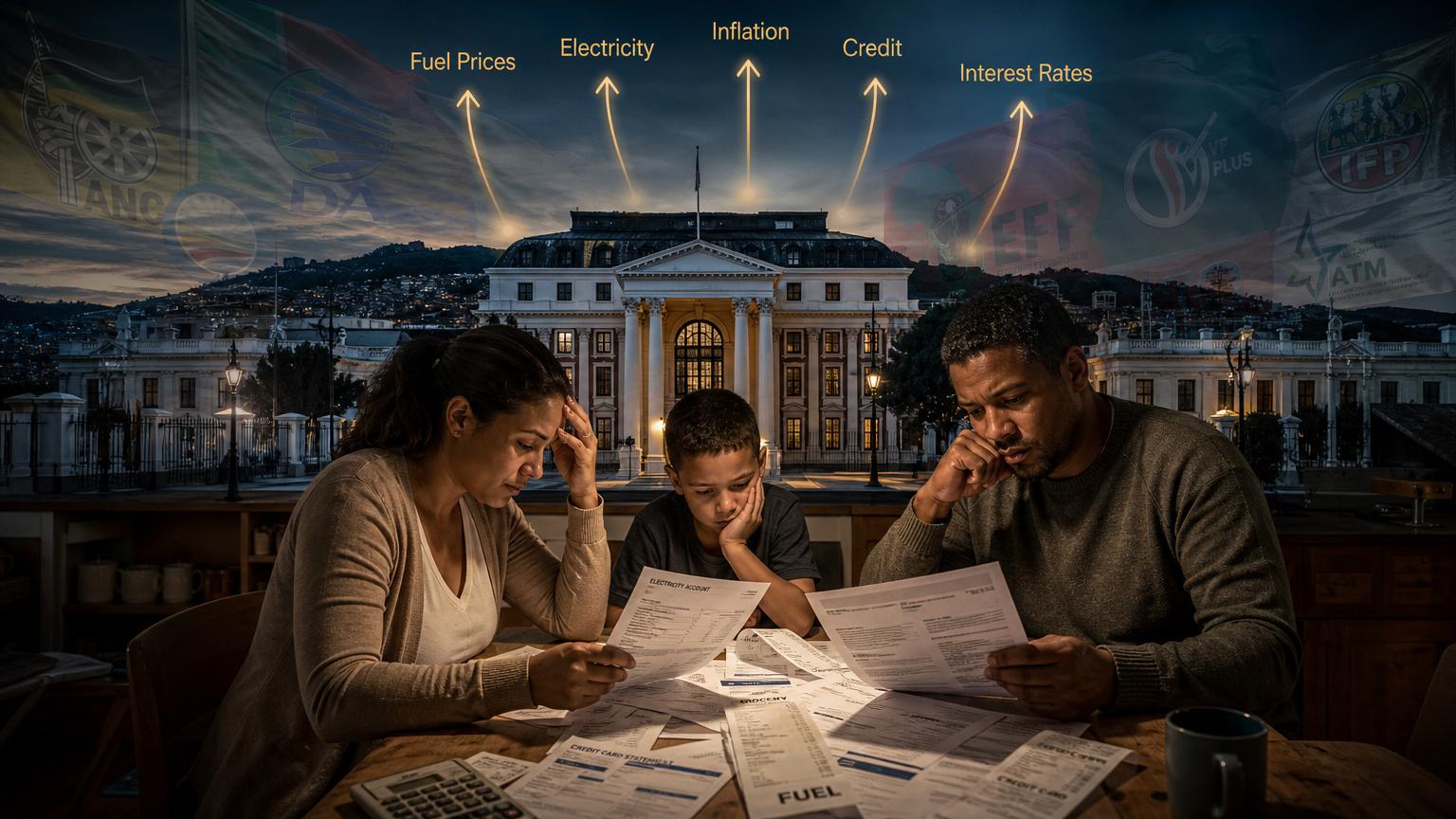
A hung Parliament forced parties into a coalition after the 2024 election.
Necessary compromise for stability, or a shift away from campaign promises?
Policy decisions shape fuel, electricity, inflation and the cost of credit.
How the GNU Was Formed
When the 2024 results were finalised, the arithmetic was clear: no party could govern alone. To form a national government and elect a President, parties needed to build a working majority in the National Assembly. That triggered days of intense negotiation.
The parties that ultimately came together agreed to a broad framework — a statement of shared intent setting out common priorities such as economic growth, job creation, stability and improved service delivery. Rather than a single party imposing its full manifesto, the GNU represents a negotiated middle ground: a programme that no member drafted alone, and that every member had to give something up to accept.
A coalition manifesto is nobody's first choice — it is everyone's compromise.
Which Parties Joined
The GNU brought together parties from very different traditions and support bases. The list below reflects the broad make-up of the arrangement as publicly reported; the exact composition and roles may evolve over time.
Largest party in the coalition; lost its outright parliamentary majority for the first time since 1994.
Second-largest party; moved from official opposition into a governing role within the unity government.
A long-established party with a strong regional base that joined the national arrangement.
A smaller party that secured a place in the coalition after the 2024 result.
A party representing specific constituencies that opted to participate in government.
Newer and smaller parties that added their support to the unity arrangement.
What unites these parties is not a shared ideology but a shared decision: to participate in government rather than sit in opposition. That decision is precisely what raises the central question of this series.
Why Coalition Governments Require Compromise
Coalition government is not a South African invention — it is the norm in many mature democracies. And everywhere it exists, it works the same way: no single partner gets everything it wants.
- Every major decision must command support across multiple parties.
- Manifesto promises are traded off against one another during negotiation.
- Ministers must implement agreed government policy, not only their own party line.
- Partners must sometimes publicly defend positions they privately opposed.
This is why a party can genuinely believe in its campaign promises and still be unable to deliver all of them in a coalition. The question voters ask is whether a party is compromising tactically to advance its goals over time — or abandoning principles it asked voters to support.
The Difference Between Campaign Promises and Governing Responsibilities
Campaigning and governing are two very different activities. On the campaign trail, parties speak to their supporters, sharpen their differences and promise decisive action. In government, the same parties inherit budgets, legal constraints, international obligations and the compromises of coalition partners.
- • Bold, specific promises
- • Clear differences from rivals
- • Freedom to set the agenda
- • Answerable mainly to supporters
- • Fixed budgets and legal limits
- • Compromise with coalition partners
- • Shared, negotiated policy
- • Answerable to the whole country
Recognising this gap is not the same as excusing broken promises. It simply helps voters judge fairly: was a promise impossible to keep in a coalition, or was it quietly dropped once the political cost of keeping it became clear? That is a judgement each reader is entitled to make.
Why This Matters for Ordinary South Africans
Politics can feel distant from daily life. But the stability — or instability — of a coalition government has very direct consequences for household budgets. Investors, lenders and businesses watch coalition politics closely, and their confidence feeds directly into prices, interest rates and the availability of credit.
Decisions made in Parliament are ultimately felt at the kitchen table.
For a family already stretched by electricity bills, fuel costs, grocery inflation and monthly debt repayments, the difference between a stable and an unstable government is not abstract. It can decide whether the next few months bring relief or further pressure.
The Economic Chain Reaction
Political stability and instability move through the economy in a fairly predictable chain. Here is how a coalition's credibility can end up affecting the price you pay:
Stable, predictable government encourages investment; uncertainty makes investors cautious and capital scarce.
Confidence tends to strengthen the rand, while political turmoil can weaken it against major currencies.
A weaker rand raises the cost of imported oil, pushing petrol and diesel prices higher.
Energy policy and tariff decisions influence how quickly and how much electricity costs rise.
Higher fuel and energy costs feed into food and transport prices, driving up overall inflation.
To control inflation, the Reserve Bank may keep interest rates high — raising the cost of every loan.
None of these links is guaranteed in any single month, and many other global factors play a role. But the direction of travel is well understood: stability tends to ease pressure on prices and rates, while instability tends to add to it.
Impact on the Credit Industry, Debt Review and Consumer Affordability
For the millions of South Africans who rely on credit, the coalition's economic performance is deeply personal. When borrowing costs stay high, the monthly instalment on home loans, vehicle finance, personal loans and store accounts climbs — even if the amount borrowed has not changed.
- Higher interest rates increase the cost of servicing existing debt.
- Rising prices leave less disposable income to cover repayments.
- Tighter affordability can push more households toward missed payments.
- Debt review becomes a more important safety net when repayments become unmanageable.
Debt review — the formal process that helps over-indebted consumers restructure their repayments under the National Credit Act — tends to see more demand precisely when economic pressure rises. That is why CRESA treats political and economic developments as consumer issues, not merely political ones.
Under pressure with your repayments?
If rising costs are making your debt unaffordable, understanding your rights is the first step. CRESA helps consumers hold credit providers accountable and navigate their options.
Conclusion
Whether the GNU represents responsible compromise or a drift away from campaign principles is a question South Africans will debate for years — and one that different people will answer differently. What is not in dispute is that the choices made by coalition partners flow directly into the everyday cost of living.
This article is the first in an investigative CRESA series, Election Promises vs Government Performance, which will examine individual parties in the coalition — comparing what they promised voters with how they have acted in government, and what it means for consumers and the credit industry.
Coming Next in the Series
Future chapters in Election Promises vs Government Performance will include: